
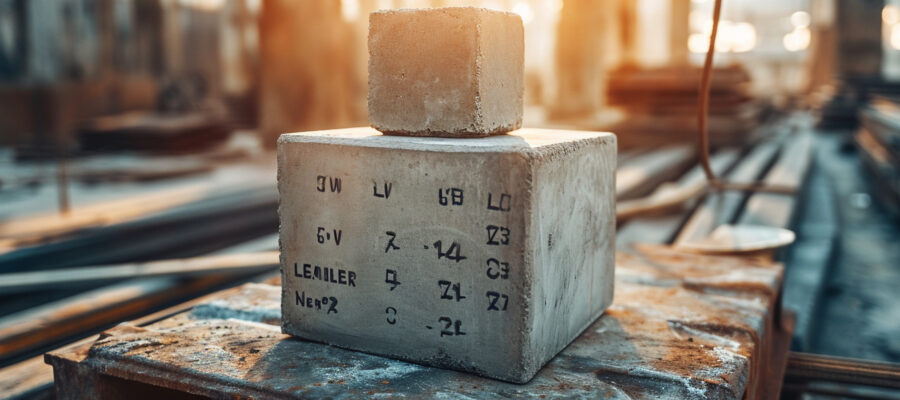
Whether you are a construction professional or simply a handyman, it is advisable to know how to calculate the weight of the concrete to ensure the safety and sustainability of the structures. This article explains how to perform this calculation using the Key elements of the dosage, the density of the materials and their volumeIn addition to discussing the factors that can influence the result.
Understand the composition of the concrete
To understand the weight of the concrete, you must first know its composition. The reinforced concrete is mainly made up of gravel, sand, cement and water. The proportions of these elements may vary slightly depending on the expected use, but in general they form a coherent and solid mixture once dry.
The water reacts with the cement to form a sticky pasta that connects the other components together, thus creating a robust structure.
Dosage of components
The concrete dosage is performed according to the type of work to be done. The standard concrete for small current work has a concrete ratio of 350 kg/m³, 800 kg/m³ of sand, 1050 kg/m³ of gravel and about 175 kg of water.
This proportion may vary depending on the presence of other adjuvants or fibers, which also strengthen the overall resistance of the structure. A higher concrete dosage will give more resistant cement, but also more expensive.

Calculation of the weight of the concrete
To calculate the weight of the concrete cube meter, we must add the mass of the different materials that make it up. The formula is simple:
Weight (kg) = density (kg/m³) × volume (m³)
The average density of standard concrete is about 2400 kg/m³, which includes individual density for each element: gravel, sand, cement and water.
Calculation of the density
To obtain the total density of the concrete, it is necessary to add the different masses of volume of the components:
Mass_Volumique_du_beton = Maxi_volume of the gravel + Mass_Volume of the sand + Mass_Volume of the cement + mass_volume of water
It should be noted that this formula is not 100% exact since it does not take into account the compactness of the mixture, the humidity of the sand or any other factor that can affect the final density. It is always advisable to check with a professional to obtain a precise estimate, As for the construction of a house, a terrace or any other outdoor development.
Application of the formula in a concrete example
Take for example a volume of 1 m³ slabs. The weight of the concrete will therefore be:
POIDS (kg) = 2400 kg/m³ × 1 m³ = 2400 kg
Therefore, the weight of a cube meter of standard concrete is about 2400 kilograms.
Video Guide: How much does a meter for concrete cube weighs?
Find out how much a cubic concrete counter, information necessary for construction professionals and amateurs who want to better understand the properties of this essential material.
Factors that influence the weight of concrete
Several factors can influence the final weight of the concrete. Among these:
Type of gravel and particles size
The choice of the type of gravel used for the production of concrete can influence its density. In fact, the different types of gravel have density that vary according to their geological origin, the size of the grains and the shape of the particles. In addition, a well -calibrated granulometry with grains that overlap correctly will get a more compact and therefore heavier concrete.
Aduvanti and fiber
The use of adjuvants or fibers in concrete can also have an impact on its weight. These additives allow you to modify some properties of the mixture, such as fluidity, water resistance or even mechanical resistance, which can cause density variations. The differences of CS are still generally minimal.
Humidity of sand
As mentioned above, the humidity of the sand can also affect the density of the concrete. A wet sand will tend to weigh heavier and induce errors in calculating total weight.
Importance of calculating the weight of concrete
Knowing the weight of concrete is essential to ensure the safety and sustainability of a structure. In fact, it allows you to adequately forget the bases, the pillars and other load elements, so that they can bear the weight of the material and applied loads. On the other hand, this helps you estimate the cost of the materials necessary for your project, which can facilitate the calculation of your quotes and the choice of a concrete top adapted to your needs.
In summary, the calculation of the weight of the cube of concrete in the kilograms requires a precise understanding of its composition, its proportions and the density of the different materials used. Taking into account all these factors, it is possible to obtain a relatively reliable estimate and therefore guarantee the success of your construction project.
latest posts published

Thyme – Everything you need to know about Timo

Modern agriculture with the help of industrial drones

Lavender culture. Rules of treatment to obtain a rich harvest

What are the machines that serve to alleviate agricultural work?

What prevention methods should you apply when using the total herbicide?

How many types of fertilizers are there and when do you have to use them?

The complete guide to the preparation of the garden in the cold season

The main agricultural works in July

Fodder Beet – Everything you need to know about its cultivation
