
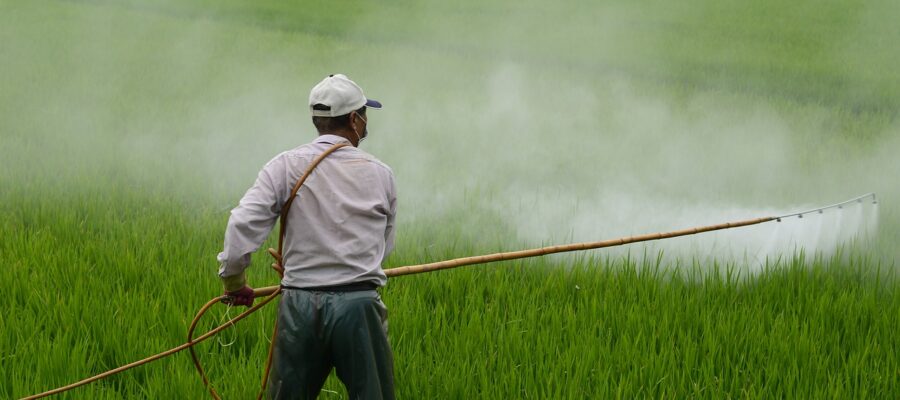
In general acceptance, herbicides There are substances that destroy weeds and protect cultivated plants, being necessary to administer the right solutions for any type of culture. Total herbicide It does not adapt exactly to this definition, because, if used inappropriately, it can completely destroy hundreds of hectares of culture. This is because it is a non -selective herbicide, which destroys all the plants that come into contact, unlike selective herbicides, which attack only the weeds in crops. Therefore, the total herbicide is the strongest substance of this interval and its application requires a series of precautionary procedures and measures, in order to obtain the desired effects.
In this article we decided to present you what are the prevention measures necessary during the application of total herbicides, so that the solution acts as an ally in the fight against weeds and unwanted vegetation.
Using the concentration indicated by the manufacturer
There are several products in the group of total herbicides on the market, but the vast majority has the main substance of the Gfosato as its main substance. What distinguishes them is concentration, which is why the way of preparing the solution differs from one product to another. The solution is simply prepared, mixing the substance with water, the proportion is usually 100-200 milliliters with 10 liters of water.
At this stage, the indications on the Prospect of the product must be strictly respected and in no case should no more substance be added in the idea of obtaining a more concentrated and stronger solution. In this way, the quality of the soil could be influenced, which will no longer be fruitful.
Application before sowing and after collection
To combat weeds from agricultural crops, the total herbicide is applied before the establishment of the respective crops or after the conclusion of the harvest. This herbicide is used to remove unwanted vegetation by agricultural lands, gardens, courtyards and other surfaces, destroying everything that means plant. In these conditions it is obvious what will happen if an agricultural land will be treated with total herbicide after the establishment of culture.
Protect plants to save
If you intend to apply plants or crops that you do not want to destroy them, it is necessary to adopt an increase in protection measures. The solution is absorbed in the plant at the level of the leaves and in this sense it is important that the splashes of herbicides do not come into contact with the leaves of the plants you want to protect.
The simplest protection method is the application of a plastic foil on the plants or the fence of the area with a material through which the solution cannot pass.
Individual protection when the total herbicide is used
The preparation and application of total herbicide solutions do not involve special health risks, but some precautionary measures are needed, recommended in all situations on which chemicals are processed. The main warning that you will find on the whole packaging of products in this range is related to avoiding contact with the skin and eyes, since irritation could occur.
In the situation in which the soil on which the treatment is applied has a small surface, it is possible to use an atomizer or manual pump, but you will have to protect yourself. Therefore, it is advisable to wear a dress or long sleeved clothing and long trousers, to avoid contact with the skin. You also need protective glasses and it would not be bad to wear a mask, to avoid inhalation of the spray solution.
After use, it is necessary to wash your hands and clean the equipment used. Last but not less important, the unused solution is maintained in a place that is not available for children, in a labeled container, so that it cannot be confused with other substances used in the family.
The total herbicide does not apply in rainy periods
For maximum efficiency, the total herbicide is applied on sunny days, when the forecast of time does not announce the rainfall for the next period. As I said above, the solution penetrates the plants at the level of the leaves, it takes for a period of time. If the application of the treatment is followed by a rain, it washes the herbicide sprinkled leaves and the effect of the solution will be considerably reduced.
It is also recommended that the treatment is applied when the plants to be destroyed have reached a certain phase of development, the greater the leaf surface, the better the absorption of the herbicide.
Given its very strong action, the total herbicide also aroused some disputes, in particular the relative to the harmful effects that glyphosate, the main active substance in the composition of herbicides in this category, would have on the health of humans and animals. Since the studies that support the damnation of glyphosate are not very final, at the level of the European Union, the approval of its use has been extended until 2022, despite the opposition of some Member States and a new evaluation will be carried out at that moment.
Photo source: pixabay
latest posts published

Thyme – Everything you need to know about Timo

Modern agriculture with the help of industrial drones

Lavender culture. Rules of treatment to obtain a rich harvest

What are the machines that serve to alleviate agricultural work?

What prevention methods should you apply when using the total herbicide?

How many types of fertilizers are there and when do you have to use them?

The complete guide to the preparation of the garden in the cold season

The main agricultural works in July

Fodder Beet – Everything you need to know about its cultivation
